


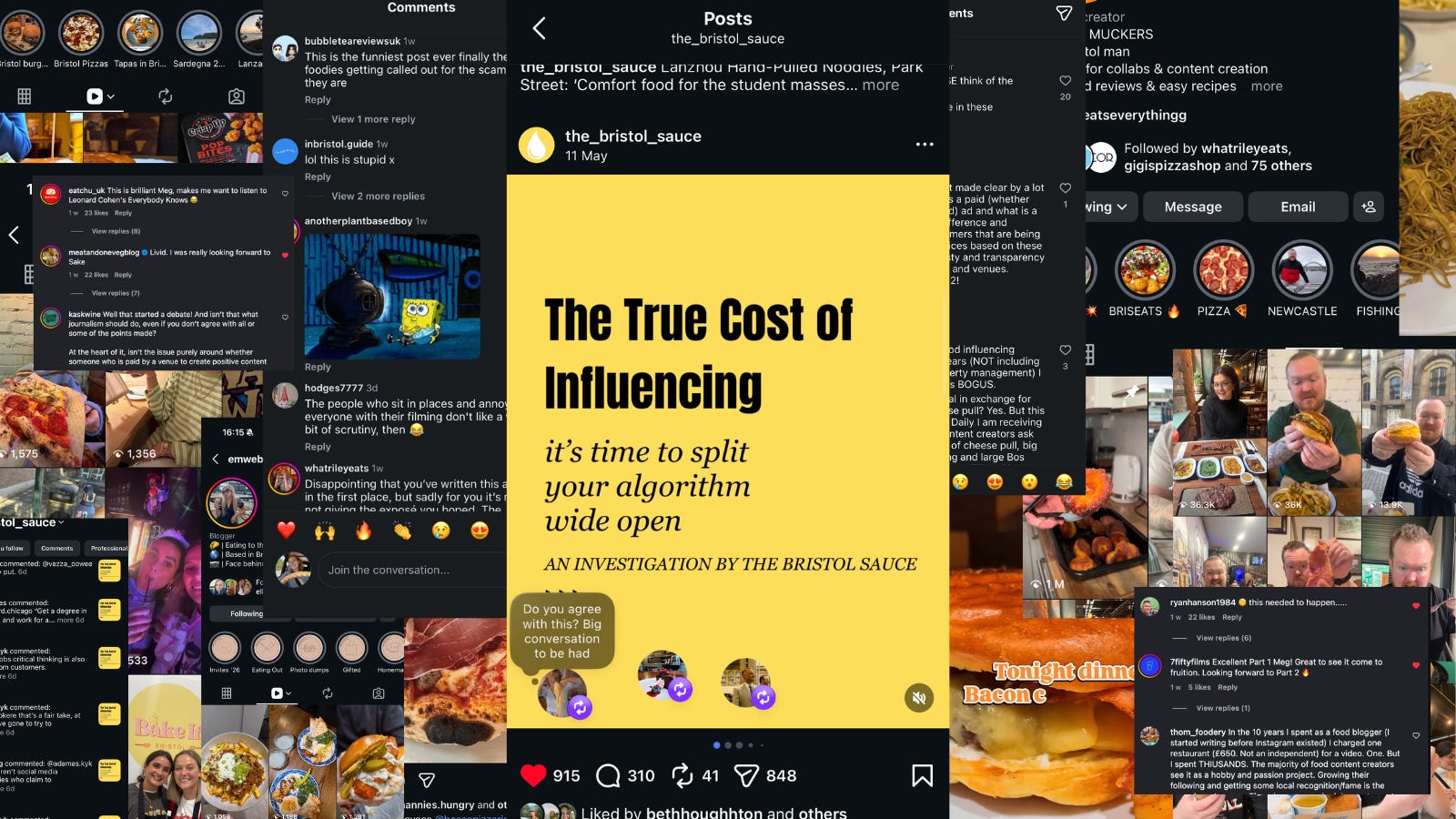
I hadn’t intended to publish a third part to this series — parts one and two were lengthy enough as is. But these articles have incited very passionate conversation; one that clearly needs to be had. As I mentioned in part two, it is good practice in journalism to offer people the right to reply when they stand accused of wrongdoing or in the case of controversy; and that is what I intended with part three. However, perhaps unsurprisingly, most of the influencers did not wish to answer my questions. I had hoped to give them the opportunity to share their thoughts and perspectives. Nevertheless, the debate that ensued in the comments section is (in parts) valuable, and so I have used some excerpts here, in combination with thoughts from restaurateurs and the one content creator that was willing to share their perspective.
Thanks to the following people who answered my questions for this article:
Dan O’Regan (Dan) — Co-owner of BANK and Lapin, and author of Notes on a Napkin
Verity Foss (Verity) — Co-owner of Oowee
A marketing manager (MM) of four independent restaurants in Bristol, who wished to remain anonymous
A content creator (CC) with ~10,000 followers on Instagram, who wished to remain anonymous
Have you worked with content creators? If so, how have you found the experience and was it beneficial for your business?
Dan: “We’ve worked with content creators at both BANK and Lapin, although we’ve never paid anyone to come and eat with us. Lots of influencers have booked tables of their own accord, paid in full, and posted about it. A handful have come in as our guests after we’ve reached out to them.
“What I get a lot of, and I mean a lot, are cold DMs asking for a free meal in exchange for a post. Small creators with no prior relationship to either restaurant, often with significantly smaller followings than our own restaurant accounts. There are also visitors to Bristol sending blanket emails to anywhere with a kitchen. I know they’re blanket because the same pitch often lands in my personal Instagram inbox as well as the restaurant pages. The bloody cheek of it. I’ll never work with anyone who pitches like that.
“When I do send an invite, it’s because I think it’ll genuinely move the needle for us, and I do it on a pretty limited basis. The results can be tough to gauge, to be honest, so I tend to be cautious. I also tend to only invite people I know to be decent. An inconsiderate table can have a real impact on the other guests in the room and on the service as a whole, and a smooth shift will never play second fiddle to a creator’s visit. The people I’ve dealt with have almost always been pleasant, polite, and happy to let service unfold around them.
“Some visits have produced a noticeable uptick in bookings. Others haven’t. I’m wary of anyone who claims to guarantee grandiose results.”
thomfoodery’s comment from Instagram: “In the 10 years I spent as a food blogger (I started writing before Instagram existed) I charged one restaurant (£650. Not an independent) for a video. One. But I spent THOUSANDS. The majority of food content creators see it as a hobby and passion project. Growing their following and getting some local recognition/fame is the appeal — not money. There is no money in doing restaurant reviews 😂 Only a handful will get big enough to end up making more than they spend, and those are the ones who went full time after years of providing value to independent restaurants with their own money. If a restaurant contacts a creator, of course the meal should be covered. If they offer a small fee on top, that money will generally go straight back into hospitality.
“I’d put good odds that most Bristol food influencers put WAY more money into the independent food scene than the author of this piece (Meg) does. And yes, there are some rotten eggs. I have managed Instagram accounts for local restaurants for years and I see them in the inboxes like vultures, asking for “collabs” with nothing to back it up. It’s frustrating, and I get why restaurants feel frustrated and burned by it. Don’t even get me started on engagement pods. But that’s it, a few bad eggs. Same as any industry. Probably not as many in journalism.
“Done right, working with the right creators can transform a business overnight. The spike in footfall from a viral video might only last weeks or months, but the long-term impact can be significant. I’ve seen it happen. I’ve done it myself. I have the messages from grateful restaurant owners to prove it. This piece raises some valid points, but it also reeks of a food journalist with a degree who’s bitter that someone with a few thousand followers, pizza hanging out of their mouth and a LED light in their hand, has more reach and influence than they do… and probably ever will!”
Verity: “I think the main creator we’ve consistently worked with is Bos Finesse, and honestly I’ve always been really happy with the content produced. The work we’ve done together has mainly been paid campaign content around launches or specific products, where he creates videos focused on the campaign itself rather than a “review” as such. You really do get your money’s worth in terms of the quality of the video and the amount of time and effort him and his team put into the content. He also regularly posts about us off his own back when he wants content for his page, and that’s never been in exchange for anything.
“What I personally think he does well is balancing paid campaign work with authenticity. He’ll still go out and review places independently and often buys the food himself. I think that balance is important and, honestly, I don’t think you can really fault his ethics or authenticity as an influencer.”
MM: “We’ve invited them in for everything from launch parties to helping promote happy hours. We’ve seen varying levels of success, though overall I’d say it’s impossible to attribute any uptake in business to a content creator, and any claiming to be responsible for this are being irresponsible and undermining the hard work of the restaurants themselves. I’ve seen our restaurants suddenly be ‘put on the map’, so to speak - higher search volume in the locality, more direct messages on social media, an uptake in followers.
“This is great for engagement, though rarely translates to real footfall. We take our influencer campaigns with a pinch (or handful) of salt, and are aware that they can help raise awareness amongst a local audience but cannot directly affect the business measurably. I’d say our most successful ones have been unpaid campaigns using micro influencers, outside of the clique of Bristol food influencers we all know."
“We’ve also experienced a strange phenomenon when inviting creators in on a free-meal basis with no fee. Minutes after sending off carefully written invites to a select few handpicked creators, we received an influx of messages from across the city asking to be invited in. It seems that they must have had a group chat and tossed in ‘this restaurant is giving away freebies, dm them’. I get that work has to be found and it’s great they have such a supportive network, but to a smallish restaurant it can feel like the vultures descending and taking advantage.”
Prior to this article, did you know that restaurants are equally culpable for failing to declare ads under the DMCC Act’s guidance?
Verity: “If I’m honest, I didn’t actually know this until reading the article. I always assumed the responsibility sat mainly with the influencer rather than the restaurant itself, so it was definitely eye-opening.”
Dan: “Honestly, no. I had no idea, so I've learnt something already from the piece.”
Do you trust the engagement you see on influencers' posts?
Verity: “I’ve always known to pay more attention to views than likes or comments, but I genuinely had no idea about engagement pools and some of the practices mentioned in the article. It would definitely frustrate me if I paid for influencer marketing and later found out the engagement wasn’t authentic.”
Dan: “I’m a restaurant-goer as well as a restaurateur, and I’m always looking for reputable sources to add places to my list. That includes influencers. Some I trust, some I don’t.
“I’m pretty au fait with the local accounts, and I see the same names cropping up commenting on each other’s posts. Obviously that does something for the algorithm, but it doesn’t tell me much else.
“When I’m looking at an opportunity, I’ll ask for a breakdown of the following by location, then look at the engagement and views with that in mind. At the end of the day, fifty million views don’t matter if they come from the other side of the world. I need views that are likely to convert to reservations. What we’re interested in is a smaller, focussed local account with a following that actually shows up. Basically, not all engagement is the same, and working out which is which is part of my job.”
MM: “This is a tricky question. I trust the numbers to an extent but don’t use them to measure an influencer’s success. Scrolling through Bristol’s food creator profiles in turn uncovers the cronyism of it all — the same 5-10 creators commenting on each other’s posts, sharing and supporting one another. Don’t get me wrong, this is great for them! However, it undermines the authenticity of these promotions to me. There’s only so many times I can see the same creators drooling over their pal’s post and saying they literally cannot wait to go. Will they actually book in without an invite? Speaking from experience, I highly fucking doubt it.”
CC: “I've not seen or been invited to an engagement pod since before lockdown. I don't think they're an issue, even if there was, it’s more to curb Instagram’s continued attack on engagement. Most of the food creator community have become very good friends through their love of food and naturally will message and like each other’s posts because friends pop up on your feed more often, there's absolutely no conspiracy. The issue years and years ago was buying followers which I feel was a much bigger issue for venues.”
Say a restaurant owner reading this is trying to decide whether to spend £500 on a creator versus £500 on a Meta ad. What's your honest case for why they should choose you?
CC: “Meta ads and creator content have a completely different impact.
If a restaurant was to use a Meta ads, what content would they be using? More than likely content already created by a content creator or freelance food photographer, a lot of restaurants don’t have time for creating content. I always personally add their content to a Google drive for them to access as it’s as much their content as is it mine. Meta ads are personally annoying and are often scrolled past by viewers. People have been following certain creators for a long time and will hopefully engage more.”
Do you think there are problems within the influencer industry and if so, what are they? Have you ever witnessed them firsthand?
CC: “I feel there are problems in any industry and understanding the industry, but mainly transparency. Firstly most influencers do it for free food. Unless they're full time and rightly so charge for their content like any other freelancer in any chosen industry.
“The onus is on everyone in the industry, creator, venue and viewer. A creator should declare ads, a venue should request and check it's been declared and viewers should question whether is an ad, if they feel it could be.
“I've always been aware of ASA and CMA guidelines, always have ad in bold and declare ads. I feel it's a good thing for more powers for it to be enforced.”
What are the positive and negative effects of influencers promoting restaurants, do you think?
Verity: “I think one of the negatives is that it can become difficult to know what’s genuinely great when everything online is being presented as amazing. It can also mean restaurants with bigger marketing budgets outshine smaller independent places that may actually serve better food, simply because they can’t afford influencer marketing.
”I also think there can sometimes be a snowball effect where everyone suddenly jumps on one restaurant or brand, while other genuinely good restaurants get overlooked. Occasionally the hype can become bigger than the actual experience itself.
”That said, I’ve also seen some genuinely brilliant restaurants and hardworking owners completely transform their businesses through influencer marketing. Some places really do blow up overnight from one video, and that’s the positive side of it — seeing good people and good brands finally get their break.”
Dan: “‘Influencer’ is an interesting term, and we all kind of know what it means, but in practice it’s anyone with influence. A journalist, a celebrity, a respected chef: they all fall into a similar bucket when we’re talking about who can shape what people think of a restaurant.
“For me, it comes down to authenticity and motivation. An opinion that can be bought and paid for, regardless of how the person actually feels, doesn’t carry any weight. Someone with integrity, whose audience can trust them, is much more interesting. Of course, there’s always a question of bias in any paid arrangement, but the best creators only work with places they enjoy and genuinely rate.
“A good influencer can tell a story, and help get new eyes on a restaurant. Yes, that can mean a few extra bookings on the night, but it can also help diners find a new favourite, or encourage someone to try something new. Whether we like it or not, influencing is how a lot of people make their decisions, and we can embrace that when it’s done well.
“The problem comes when there’s a shroud of mystery over the circumstances, or a lack of integrity behind the scenes. Deception is unfair to the person on the other end of the content.”
Charlievivante on Instagram: “The fundamental issue seems to be around the same misunderstanding, which is the difference between a food blogger and a food influencer. One writes for the love of it and occasionally accepts an invite. The other is a marketing tool you can pay to use, just like hiring a PR person or running Meta ads. It’s a transaction, not a scandal. It seems to me that most people on all sides of the argument don’t understand the difference, including the influencers themselves, and the murky distinction is part of what leads to this faux outrage. I built my entire freelance career from food blogging. Now clients pay me to tell people what they do is great. Am I now part of the scandalous group of people asking for payment for work? The majority of people named and shamed here are hobbyists, people with a nice Instagram who’ll often do hundreds of pounds’ worth of work in exchange for a free meal. I’ve worked with many of them on client campaigns. The ones who weren’t any good simply weren’t asked back. Anyone not declaring a paid partnership hasn’t got a leg to stand on, and that’s a real issue, but overwhelmingly it’s the small fish who’ve been picked on, not the actual villains. I’m also genuinely surprised at some of the businesses cheering this on, given that plenty of them have used influencers and bloggers in the past, including me. If you’ve been in this industry long enough, you understand how marketing works. This city is absolutely spoiled for people offering to do a lot for not very much, if you choose to use them. So why is hospitality still an industry where working for free is considered normal? Why is someone charging for their time and talent treated like some kind of bombshell?”
Leah.jay on Instagram: “Brilliant article 👏 I personally don’t see an issue with posting the names and fees of those contacted. If they back their fee privately with small, independent businesses then they should be able to back it publicly with the people who view/are influenced by their content. When I’m choosing a restaurant to eat at I will compare menu costs to pick one within my budget for that meal. Why would we expect restaurants not to be able to do the same when choosing how to spend a limited advertising budget? The whole influencer scene is widely unregulated and as someone who regularly eats out in Bristol this is a very useful balancing exercise between restaurant, customer and influencer. For balance, I also don’t see anything wrong with influencers charging for their time. They are entitled to remuneration for the time taken to visit, film, edit, post etc. Just all feels a bit smoke and mirrors sometimes and that’s as someone who just likes to eat nice food, must be a nightmare for indie businesses to navigate who are struggling to stay afloat as it is!”
MM: “For me the main positive can be authenticity and accessibility. I think people traditionally turn to content creators for realism. They want to see someone like them, with no contacts, no expensive setup, no marketing plan, and no celebrity budget, giving their honest opinions on something they actually care about. This can be extraordinarily successful, and I think is the main reason our micro-influencer campaigns perform better than when we use big creators. It’s easier to imagine yourself sat in a restaurant if someone ‘like you’ proves they can do it first. It’s a different effect than a food critic’s review, which usually presents the dining experience as something aspirational.
“On the flip side, the main negative is inauthenticity. Scrolling through a single account and seeing them enthusiastically declare each and every single restaurant to be ‘maybe the best in Bristol’ before reeling off the same copy pointers about price and seasonality, completely undermines what people look to these creators for. If I pay an influencer hundreds of pounds to promote my restaurant, there’s not a chance in hell they’re going to share truly honest opinions on it if disappointed.
“I saw comments on the Instagram post of part one of this study compare themselves to food critics and writers in defence of asking for pay, which I find laughable. Not only is this a slap in the face to people who’ve dedicated their lives to studying food, restaurants and the art of hospitality, but it also leaves a bitter taste in the mouths of the restaurants. When we invite an influencer in, it’s never a ‘free meal’ — it’s staffing, prep time, ingredients, interruption in service and more. I think a lot of these influencers are forgetting that they need these restaurants more than the restaurants need them.”
A final word from Meg — It seems to me that influencers are an important part of promoting restaurants and other hospitality businesses. When I think of a modern hospitality industry without them, it is clear to see that for many businesses it would be a lot harder to get discovered, and for many diners it clearly inspires excitement and inspiration when it comes to where to eat. But, as with any industry and especially one as nascent as this, there are serious issues with transparency, gaming the system and breaking the law at the expense of businesses and followers. You are reading this because you care about the hospitality industry and eating out — and therefore our aims are the same: to make sure that that industry flourishes. It can’t do that if there isn’t honesty, trust and transparency. It can’t do that if there are people regularly exploiting businesses for their own gain. You are aware of the costs and forces at play now — so you can make informed choices whether you are a restaurateur, restaurant-goer or content creator.
My intention with this article was to offer transparency and clarity where there was none, for anyone that may find it useful. Though it has been at a substantial personal cost, I have achieved that aim.
If there’s anything else you think The Bristol Sauce should investigate, please let us know.
The Bristol Sauce is an AI free publication — all our work is written and edited by humans.
Thank you for such a well-researched, in depth piece of journalism amongst a sea of opinion pieces and reheated hot takes! Thinking about some of these influencer reviews of restaurants, I’m reminded of a quote from the Simpsons when Homer is briefly a food critic for the local paper and one of the other reviewers is angry with him “Everything is a rave! 9 Thumbs up? What the hell is that??”
The blogger vs influencer distinction is key here. One pays for the meal and writes because they have something to say. The other sells access to an audience. Both fine, but conflating them is how trust gets eroded for everyone writing about food.