


A note from Meg:
I’ve been working on this piece since last September, which is the longest I’ve ever spent writing an article. Influencers are frequently in the news, and there’s almost as many opinion pieces about them as there are content creators themselves. In recent months, everyone from Gordon Ramsay to Jeremy King has had something to say on the subject. But there are astoundingly few facts available.
And so I set out to uncover some. That’s what this piece is: facts, not opinion. I shall leave you to make your own judgement about who you choose to follow, where you choose to eat, and why.
Though similar research to part one has been carried out by my friends at The Hunger in America, as far as I am aware the research in part two has never been done before and an investigation of this depth into influencers is globally unprecedented. With that in mind, if you find the following information interesting and useful, I hope you’ll share it. I think it deserves to be known and referenced widely.
I’ve been very lucky to have had a lot of help in the writing of this piece. I’d like to offer my utmost thanks to all those who helped in the research, community proofreading and checking of the article, in no particular order: Jon Robinson, Anne Marie Taylor, Tamara Collin, Miguel Alzugaray, Earnest Graham, Mark Endicott, Jonathan Swain, Michael Hawkins, Natalie Lewendon, Luke Hussey, Jen Forster, Henry Bell, PXandTarts, and the staff from the restaurants mentioned in part two.
I haven’t put either part of this investigation behind a paywall, because I think revealing this information is in the public interest. That said, if you live in Bristol and you want to support the work of The Bristol Sauce and see more investigations like this, please consider becoming a subscriber. If you’ve come from further afield or don’t want to become a subscriber at the moment but still want to show your support, you can buy me a coffee/pint/Suzuki Jimny here.
This piece is long, and so I’ve divided it into two parts - the second will be coming on Monday, 18 May. But I think it’s well worth reading, so I hope you’ll stay with me. Enjoy!
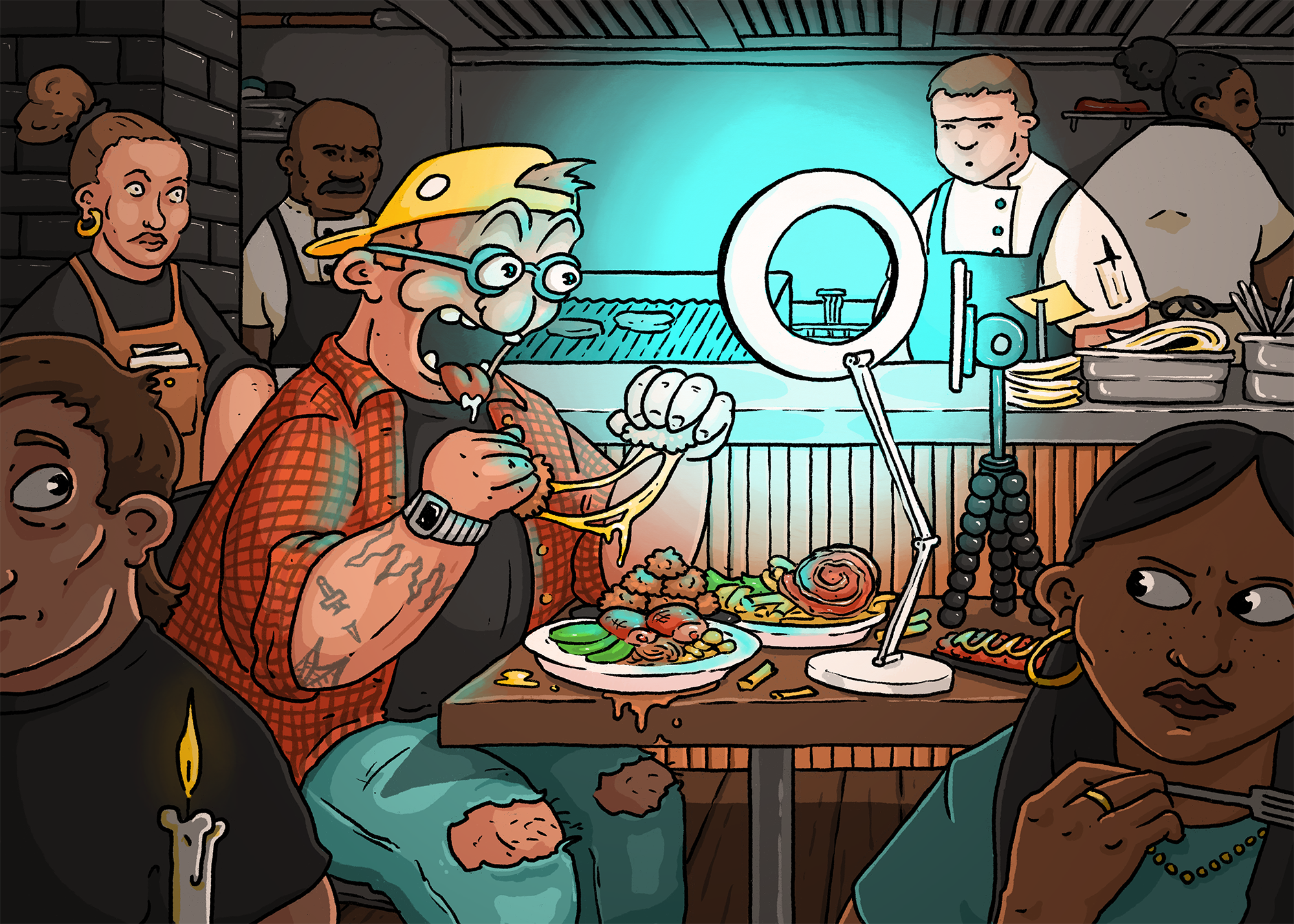
Influencer (noun): a person active on social media who is able to influence people’s opinions or to persuade them to follow a particular lifestyle or buy a particular product.
Influencers. Whether you love them, hate them or love to hate them, the chances are that unless you’ve been living under a rock, you have — at some point — been influenced — particularly if you like going to restaurants. In the last few years, the practice of influencing has exploded. Statistica estimates that the global amount spent on influencer marketing reached over $32 billion (£23.7 billion) in 2025; three times what it was in 2020. Influencers have an outsized impact in the restaurant world, where attention is key and margins are slimmer than ever.
There are many opinions circulating about influencers, but few facts. There is limited transparency about the costs associated with this type of marketing and the impact a restaurant can expect, and Bristol’s local hospitality scene is no exception. This leaves restaurateurs and business owners exposed. Given that they already have to be experts in hospitality, HR, accounting and marketing, the additional pressure of monitoring and tracking the impact of an influencer campaign on the bottom line will soon become ridiculous. As such, I thought I could help.
With this in mind, I have conducted an experiment. The intent of this experiment is not only to help those running restaurants, but also to inform you, as diners, about the forces at play behind your social media algorithms.
I had a plan of my own, which I’ll reveal in part two, but while enacting it I came across a brilliant piece published in the States about influencers: ‘Eat, Pay, Love’, by Earnest Graham and published in The Hunger. Reading Graham’s work gave me the idea of creating a fake restaurant in Bristol, which he’d done in Chicago with the aim of finding out how much influencers were charging and whether they would guarantee positive coverage.
I messaged Graham to check he was happy with me replicating his work in the UK and he was incredibly supportive, even offering to help proofread my piece.
So I started by creating a fake restaurant — a very good looking one, I might add — called Sake. I set up an Instagram page for Sake, which I populated with pictures from my trip to Japan last year. I created a website and launched it, with a custom domain and email address for my made-up manager, Joss. I wrote a menu, a very enticing one — so enticing, in fact, that within an hour of the website launching I had a journalist emailing Joss to ask for exclusive coverage in national papers. I’ve since taken the website down, as it was expensive to maintain the domain, but the Instagram page remains live, if anyone wishes to look it up.
I used Sake’s Instagram profile to reach out to 48 influencers based in Bristol and the surrounding area. I sent an identical message to each:
“Hi [Name],
Hope you’re well. My name’s Joss, I’m contacting you from Sake, a new modern Japanese restaurant coming soon to Bristol. We will be serving a refined, innovative menu from chefs who have worked in some of the best restaurants in the world. You can view the sample menus on our website.
Our marketing team is drawing up a list of creators ahead of the restaurant’s public launch to build awareness and momentum. We are reaching out ahead of time to help us plan our content strategy.
We’d love to explore a potential collaboration where you visit Sake, enjoy the menu and create content to share with your audience.
Could you please share your current rates for a dedicated post or story (Instagram, TikTok or both) and let us know:
What’s typically included in your content package?
Do you offer any guarantees regarding tone or messaging (i.e., a positive representation of the experience)?
Thank you very much,
Joss Waite, General Manager”
I got responses from 33 of the 48. Even though I’d asked for their rates, I wasn’t expecting so many to charge and I was surprised by how much the prices varied. I suspect there is little transparency even between influencers, so benchmarking is probably nigh-on impossible. I’m glad to present an opportunity to rectify that:
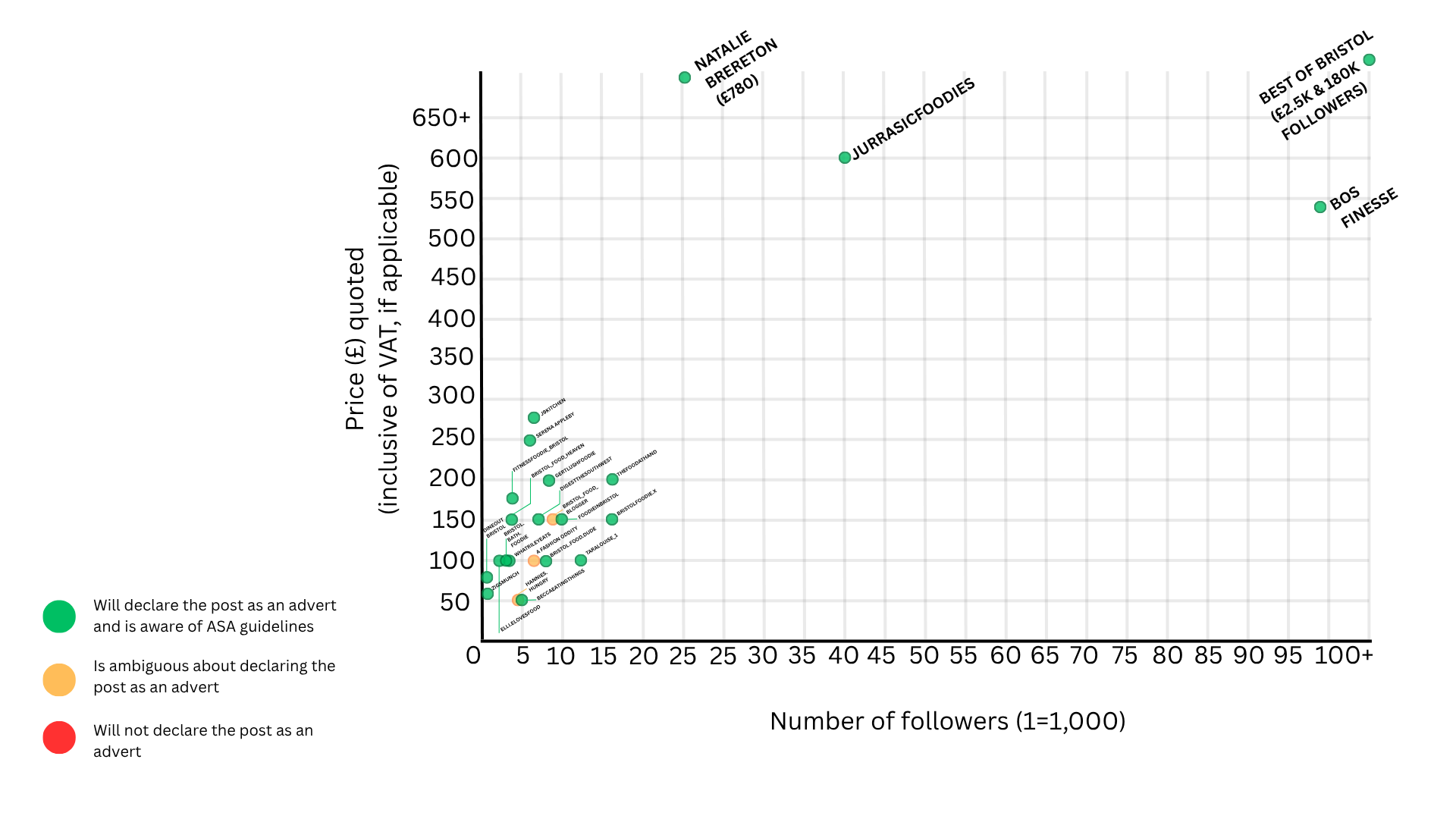
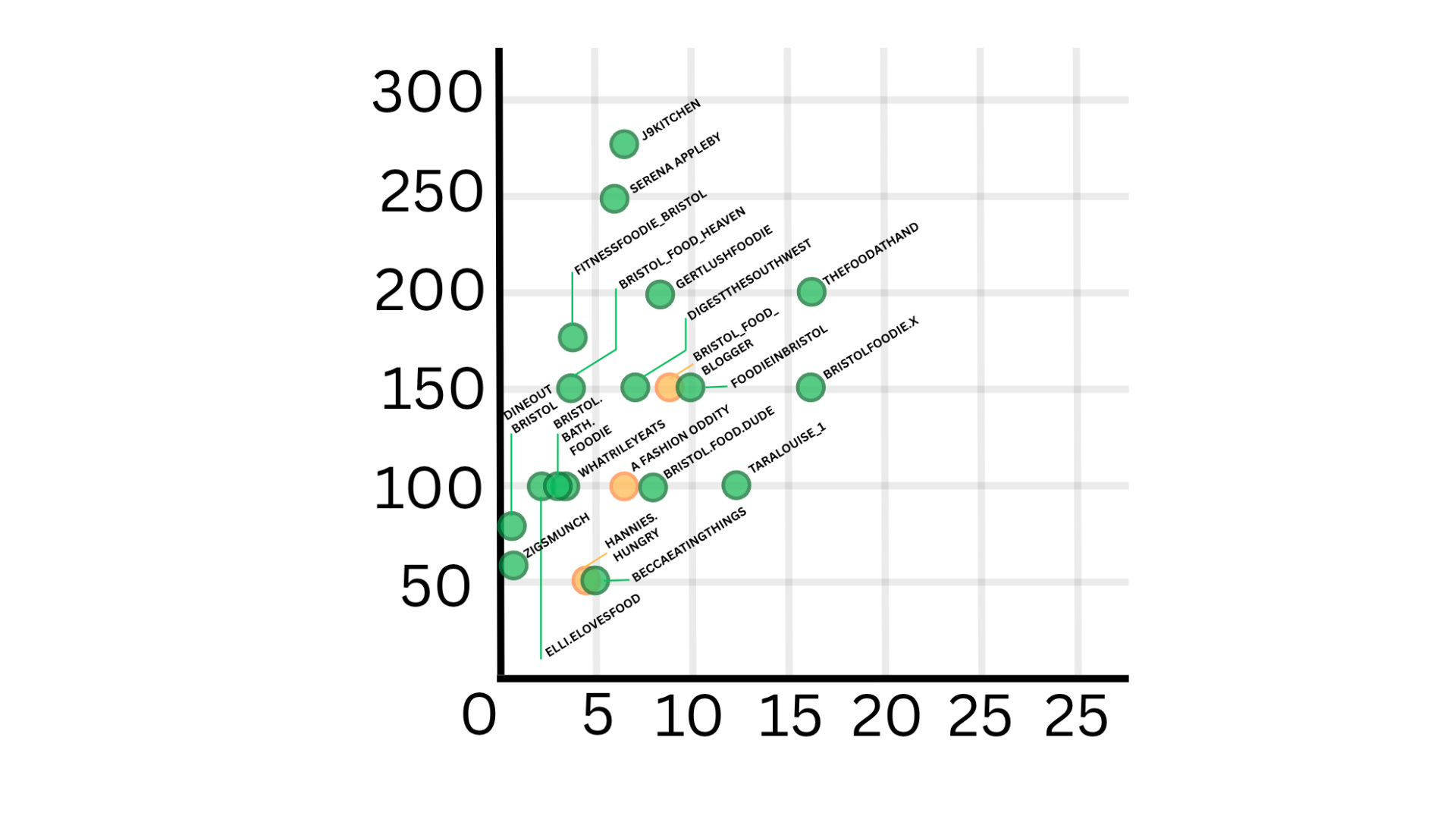
Some key things to note about the above graph:
There were ten influencers who agreed to create the content only in exchange for free food and drink, usually for two people. I have not listed these on the graph, but their follower counts ranged from 600 to 24,000. Five of these influencers said they would post without labelling the content as an advert, which is illegal, and another was ambiguous.
For the remaining 23 influencers, it was assumed that they would get free food and drink on top of the monetary payment.
The prices quoted did not include any bartering by me/Joss, and there is a chance that influencers would be willing to compromise on pricing if a restaurant asked.
The influencers may have mentally attributed a certain value to my fake restaurant, which was designed to look ‘high-end’, and may have inflated prices accordingly.
Creating the fake restaurant revealed more than just the fees that these influencers charge. Firstly, as soon as I started messaging them, many began commenting on my posts and sharing things to their stories – before I’d agreed to commission them. For a restaurant on the brink of opening, messaging every influencer in the book and asking for a quote seems therefore a great way of creating ‘noise’ without having to spend any money. For the diner, however, it’s misleading. What might look like genuine hype is in fact a load of people for whom anything between £50-£700+ is on the line from a business lead that they want to keep warm. As we’ll see later, misleading consumers is illegal in the UK and could lead to penalties for both the restaurant and the creator.
Several of the influencers I contacted included a Google review in their content package, with some mentioning how many views their Google accounts get. This bodes badly. Google ratings are one of the most prevalent benchmarks of restaurant quality, but now it is clear they are being bought. This is also against the law as it breaches the Digital Markets, Competition and Consumers (DMCC) Act 2024.
For restaurants interested in commissioning influencers, know this: follower counts do not necessarily guarantee views. This can work both ways — videos can end up with way more views than follower counts would indicate, or far fewer. It is often determined by how much engagement a video or post gets immediately after it is posted, which then determines how much the algorithm pushes it. Engagement, in this case, is anyone liking, commenting, reposting or sharing the post.
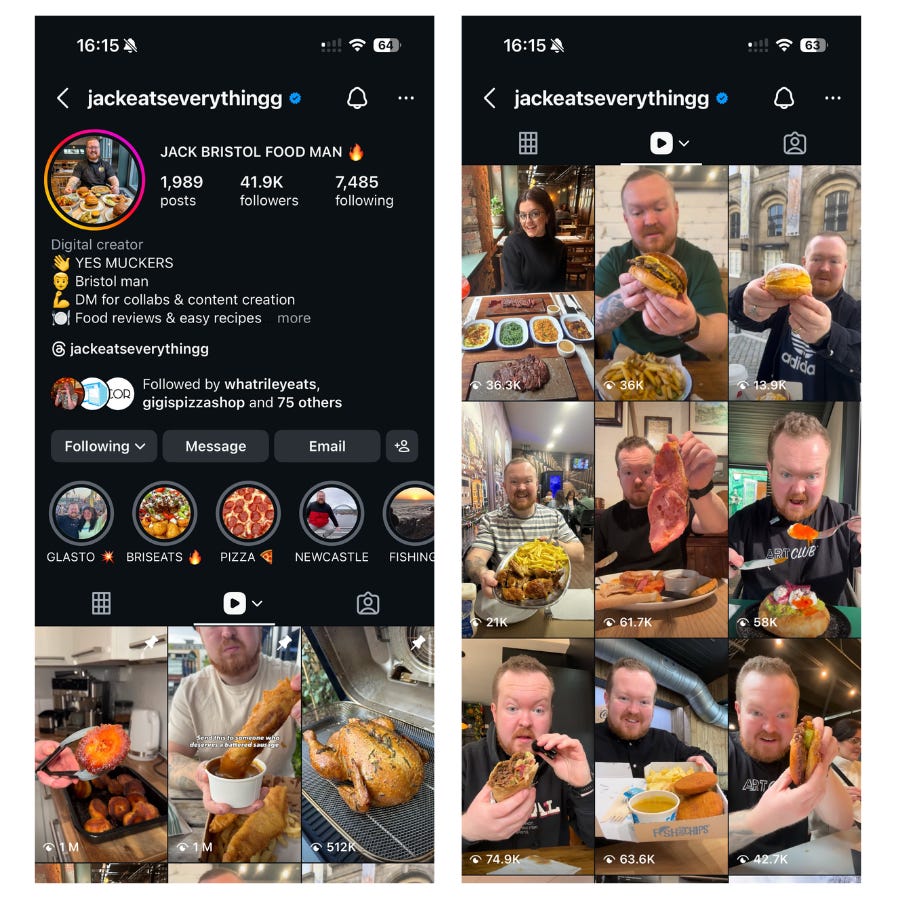
In the above images, you can see that Jack has just under 42,000 followers. Some of his videos have had as many as one million views, and he has pinned these to the top of his page so that his highest view counts appear first, which may be appealing to potential collaborators. Jack’s videos generally get more views than he has followers, though they fluctuate from 14,000 to 36,000 views just days apart.
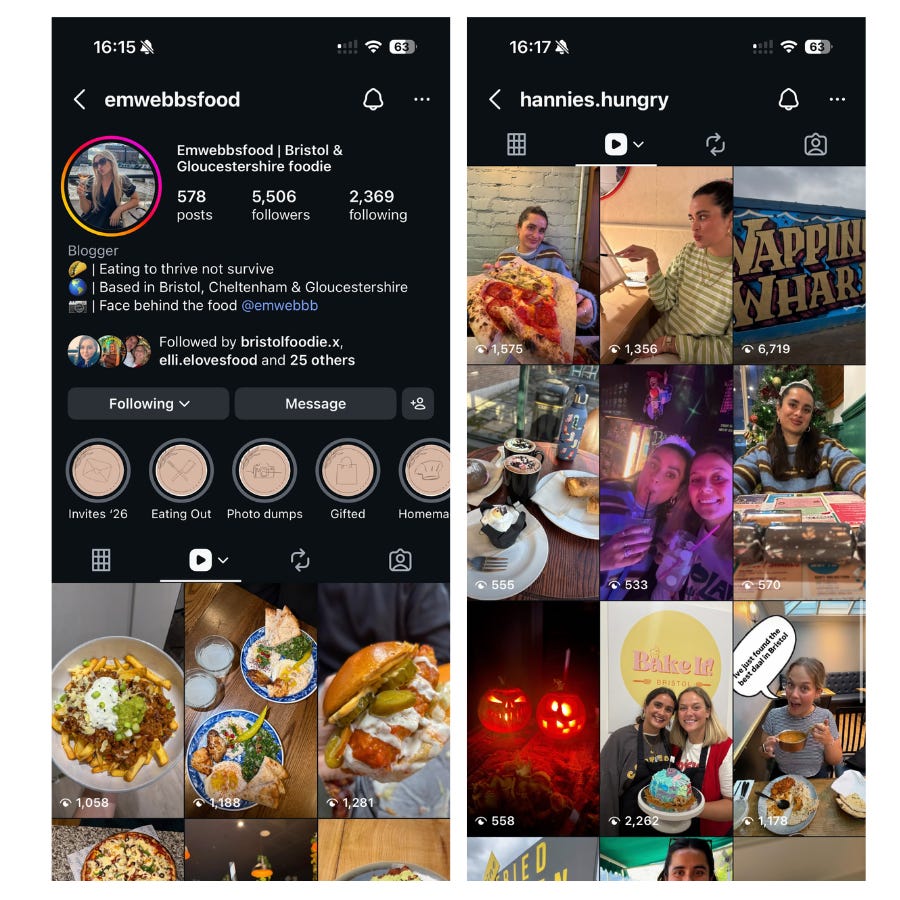
Jack is not alone. Em Webbs Food, pictured above, generally gets only a fifth of the views on her videos that her follower count suggests. Hannies Hungry has just under 5,000 followers and views vary between 500 and just a few thousand. Restaurateurs should be careful to look for average views and not followers.
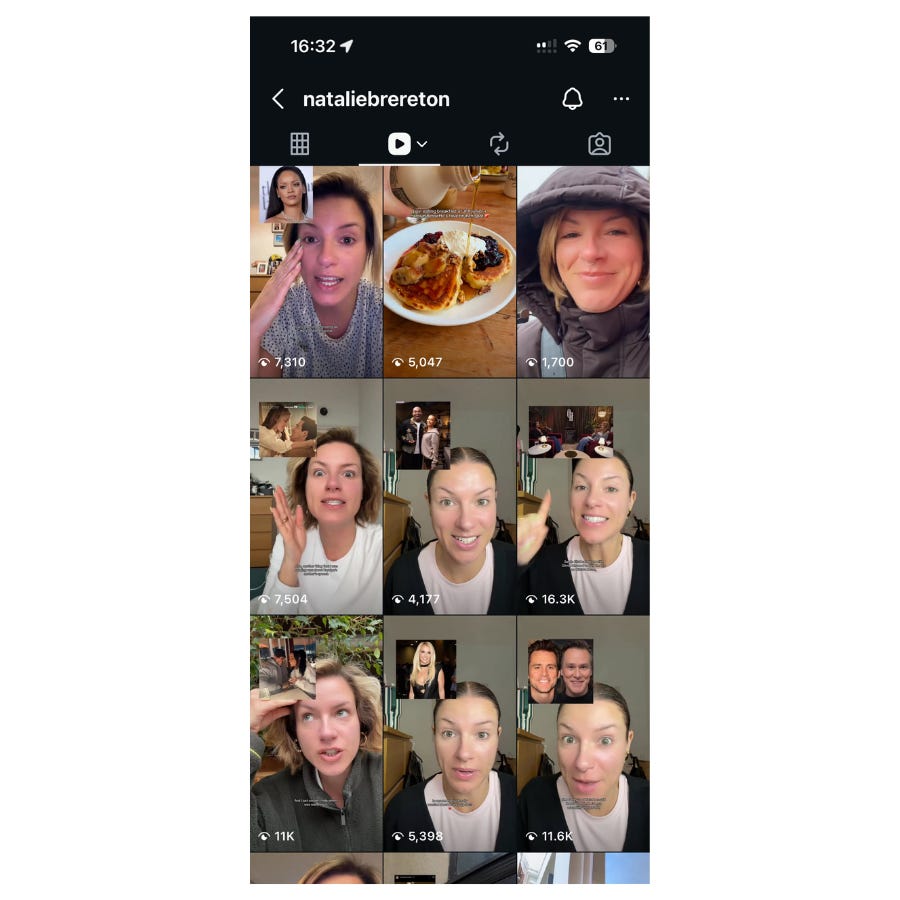
This might be why some accounts feel justified in charging so much more than others. However, one of the highest chargers on the chart — Natalie Brereton — has an average of around 8,000 views on her nine most recent videos at the time of writing (though most of these videos are about pop culture and not food).
As I spent time scrolling through Sake’s feed, I was struck by how many of the influencers were commenting on each other’s posts. I became fascinated, in a sort of horrified way, about how much of this was just one big circle of faux influence.
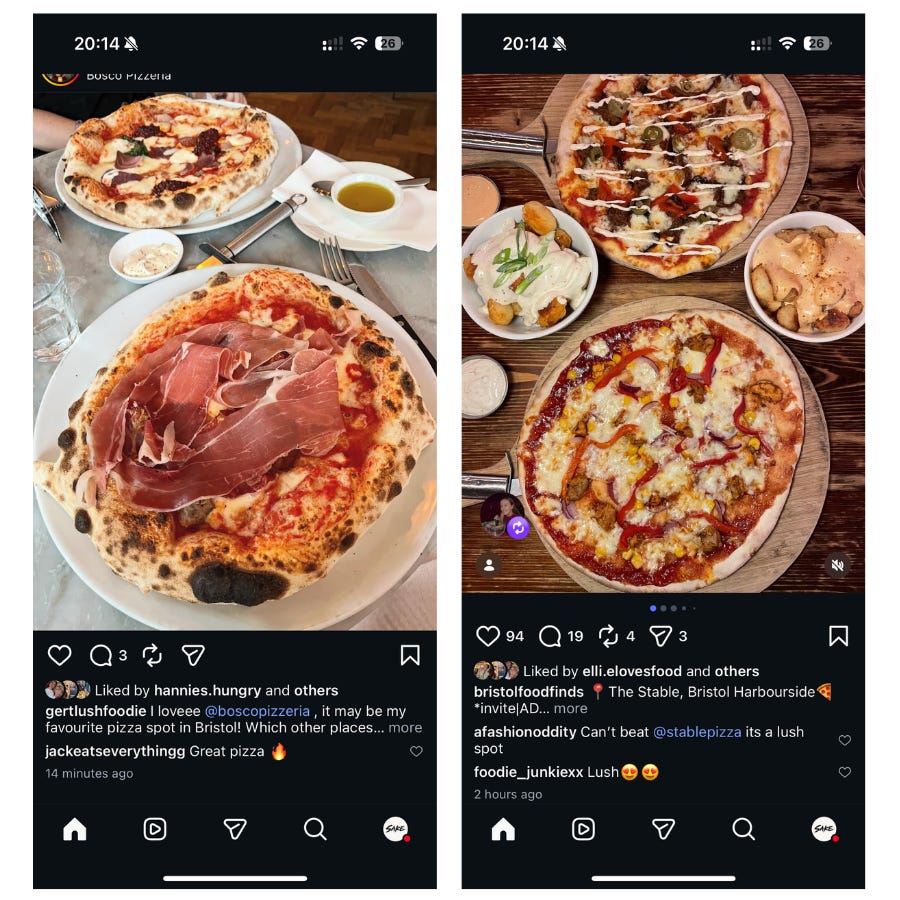
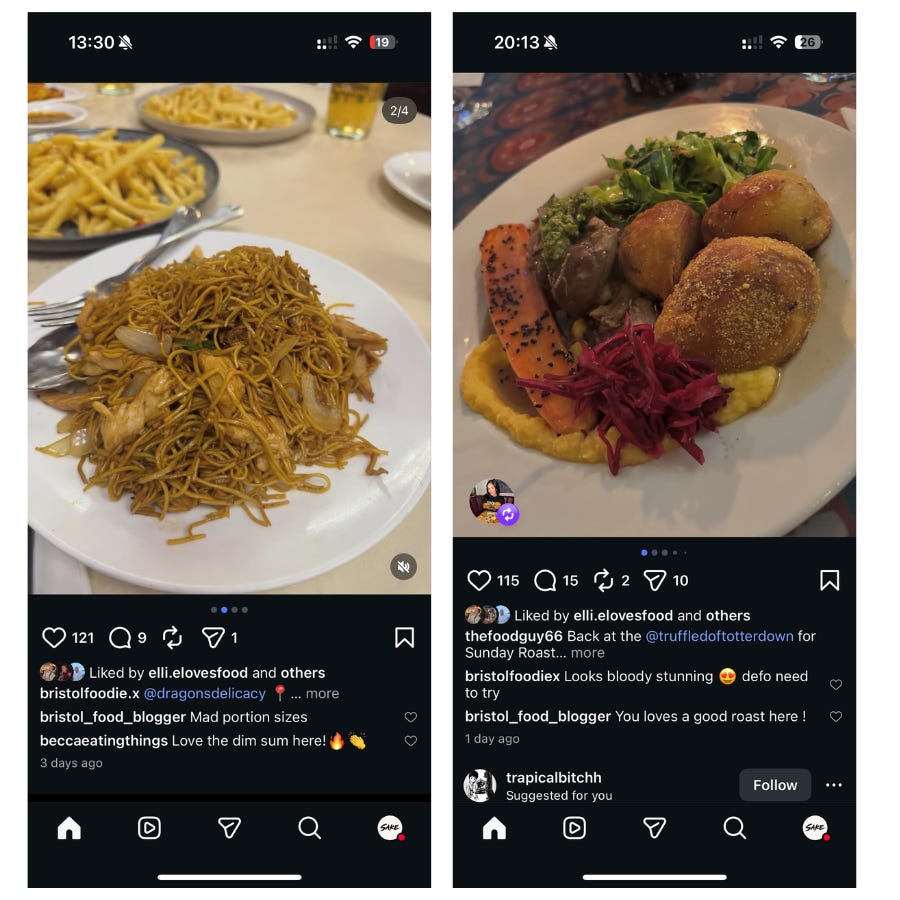
As you can see in the above photos, the top comments are almost always from other influencers. So who are they actually influencing? Perhaps they are doing this informally, to show support to their fellow content creators. But research suggests something more sinister may be at play. I encountered messaging groups on Instagram with members based all over the world who swap likes and comments on each other's posts. These groups get flagged and deactivated by Instagram, as the parent company Meta is presumably aware that this fools the algorithm.
Creators have got around this by writing messages to the group in which letters are replaced by numbers to prevent automatic detection. These ‘l1kes’ and ‘c0mm3nts’ groups can be found quite easily — simply search ‘engagement groups Instagram’ on Google — and they do not seem to have any geographic restrictions. This means restaurateurs may think they are getting good engagement from Bristolians when they commission a video, when it is in fact a set of people with no intention of ever visiting their restaurant who could be based anywhere in the world. This, too, could be illegal in the UK. Depending on the agreement with the restaurant, it could be in breach of contractual law. False engagement could also be misleading to consumers.
This is very apparent when you examine some influencers’ engagement-to-view ratios. Average engagement rates (the number of comments, likes and shares a piece of content gets) on Instagram generally hover around 2-3 per cent. Ciaone_UK_foodie, who appears to be based in Bristol and has ‘DM for collabs’ listed on their profile, seems to be smashing the engagement. Take a look at the screenshots below:
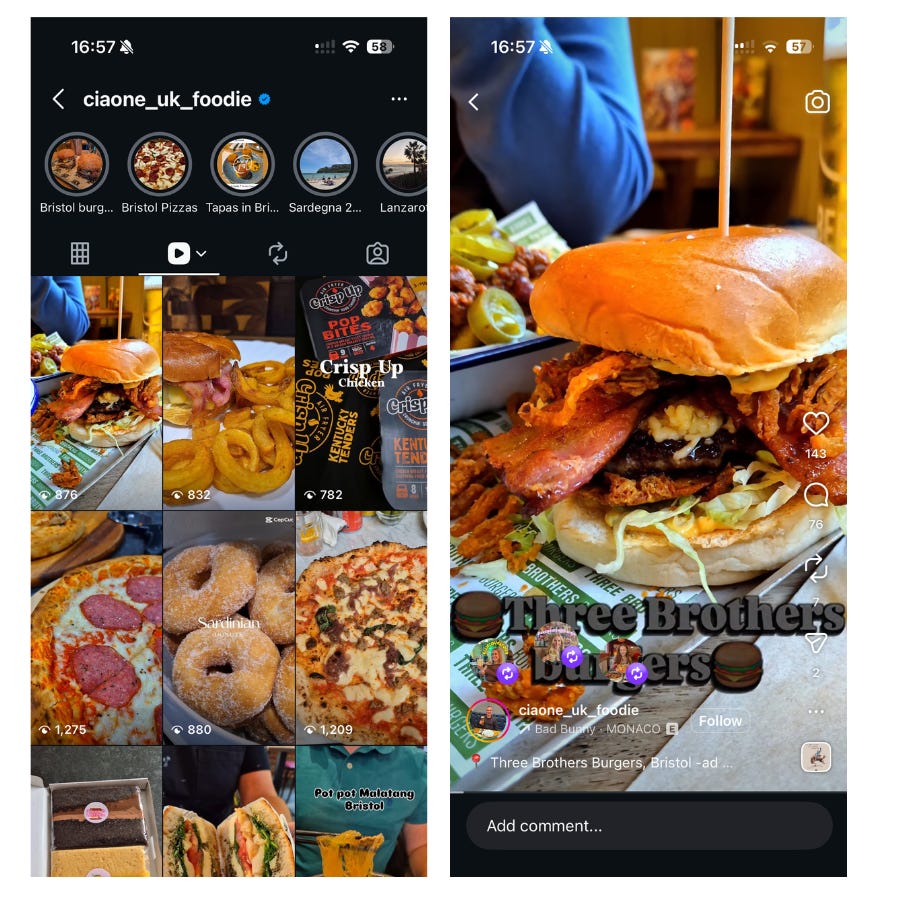
Here we can see that this influencer got 876, 832 and 782 views on their last three videos, at the time of writing. Look at the likes and comments on the same three videos:
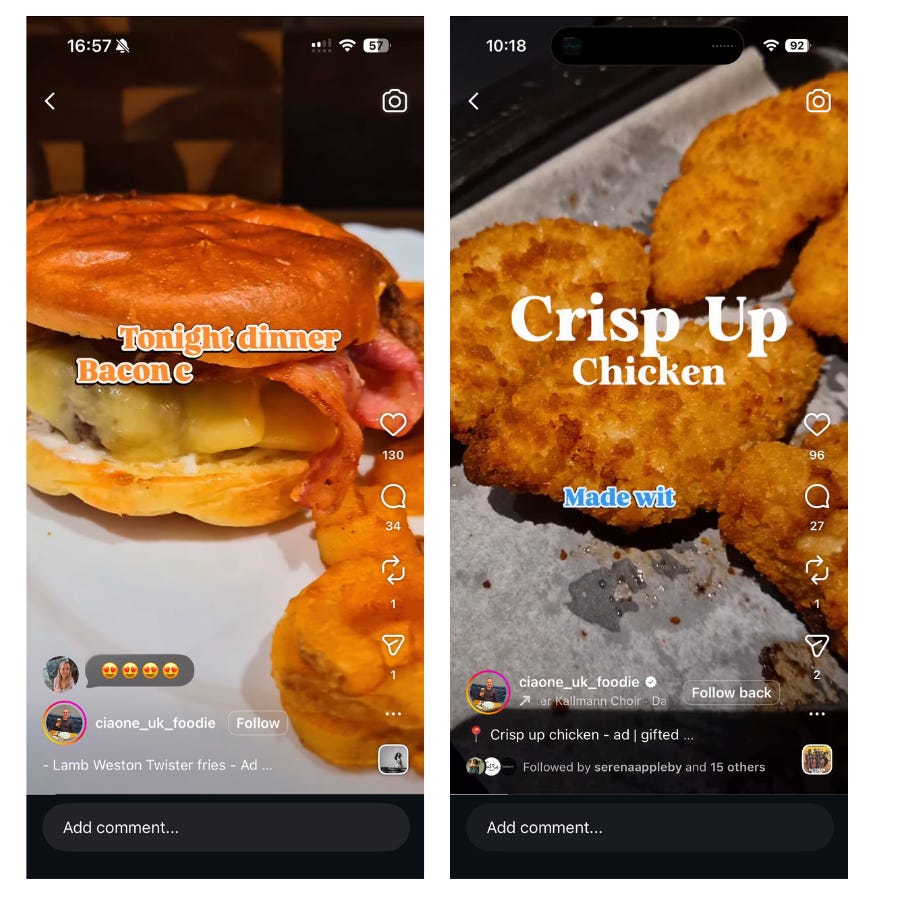
The first video has 876 views, and 143 likes. That is a 16.3 per cent engagement rate, before you bring the comments into the equation. The second video is 15.6 per cent and the third 12.3 per cent, also without comments — this is well above average for engagement.
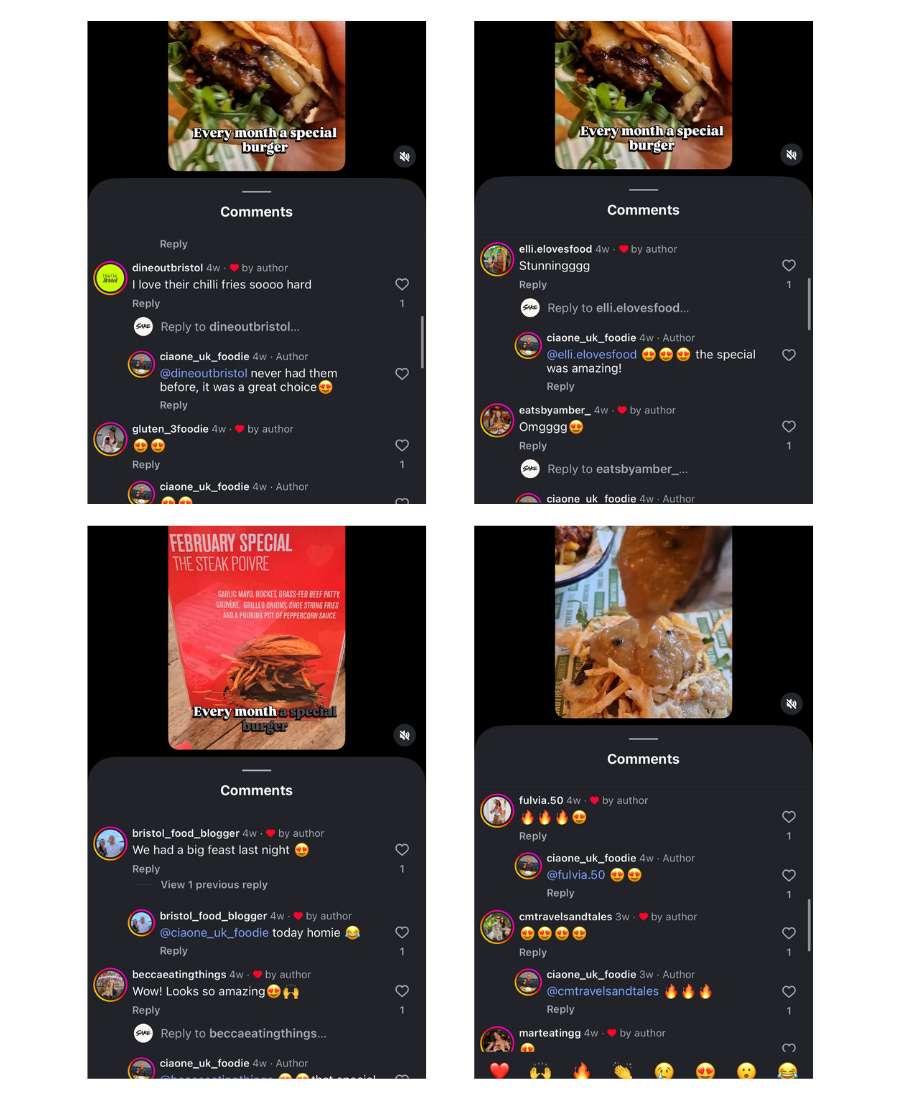
Furthermore, if you dive into the comment sections, it is abundantly clear that almost all of the engagement is coming from other influencers. Often they don’t even bother with words.
In the process of conducting this research, I interviewed an influencer — one of the ones who had also been approached by Sake — and the general manager of a Michelin Guide restaurant for their perspectives on the phenomenon of influencing. Their thoughts are peppered through parts one and two of this article.
“In my circle of friends, there’s no agreement to comment and like each others’ stuff. Last year I was invited to a random group chat by a guy talking about how we can support each other and like and comment but I thought “that’s lame” and left immediately” - Influencer
The reason all of this matters is because when influencers reach out to restaurants, or respond to messages about packages, they often back up their prices with statistics about their followers, views and engagement levels. It is clear that in some cases, these statistics may be at the very least heavily inflated. If a restaurant that had commissioned an influencer became aware that this was the case, then the influencer would have broken the law and be in breach of their contract.
Another concern was that so many of the influencers who responded to Sake were happy to guarantee positive coverage. Responses ranged from saying that they’d bring negative feedback directly to the restaurant and that anything that went online would be positive, to assurances that they would not post anything if the experience was negative. Only one influencer responded that if the experience was bad, they would say as such online and would expect to get paid. Whilst this shows the influencer has no wish to mislead followers with exclusively positive reviews, it also creates an odd situation: a restaurateur paying for negative marketing. Only this influencer, out of the 33 that responded, would be willing to share any negatives with their followers. Others said they wouldn’t post and wouldn’t expect any payment. Most said that this had never happened to them.
Astoundingly, several influencers responded that they wouldn’t visit a restaurant they wouldn’t enjoy. This suggests that they are able to see into the future, and even more amazingly, into the future of a restaurant that doesn’t exist. One influencer said the following:
“Regarding the content, we always offer a positive representation of the experience, as we carefully select brands we genuinely believe in to keep our page a positive resource for our audience. To maintain full integrity and transparency: if we were to have a genuinely negative experience, we would terminate the contract, refrain from posting any content, and would not accept payment for the ad. We’ve never had this happen with a paid collaboration because of our careful selection process.”
When questioned on their ‘careful selection process’, they said: “we examine the menu, the vibes, the way the food looks, any other reviews we’ve heard of, any info from word of mouth about the restaurant and then go from there”. This is remarkable, given that the restaurant they selected in this instance has managed to pass the ‘careful selection process’ despite the fact that it is entirely made up.
Whether some of these influencers can actually tell the difference between a good and a bad experience is also uncertain. Watching their reels through Sake’s Instagram, I came across one line that stayed with me: “the authenticity of that slap factor is just insane”. You can’t argue with that.
On a personal note, spending time on Sake’s Instagram was thrilling at first, giving a fascinating insight into how this world works, or doesn’t work. But before long I started to feel really depressed by it. It was like driving past a car crash — it was horrible to watch but I couldn’t look away. Every video was almost identical, and the whole thing started to feel like an episode of Black Mirror. The more I realised that many of the influencers were just in one enormous circle, influencing each other with the same regurgitated content and charging restaurants for it, the more miserable I felt at the state of the world and social media. It was a relief to log out of Sake’s account and back into my own, which is filled instead with videos of cats and people falling over.
“There is a side of it that I hate. There’s so much content I can’t stand, it’s overly saturated, it’s all the same. I think there is a whole group that doesn’t know what they’re talking about — they’ve not really travelled. And that doesn’t have to be travelling physically, you can travel by reading, watching documentaries and having a genuine passion for food and different regions and countries. There’s a lot of people that are in this influencer circle who don’t understand the nuances of Asian food, for example. Asia is a massive continent with so many countries. The differences between the countries in South East Asia alone are vast. If you go into Viet Kitchen or Saigon Kitchen — they’re not Asian, they’re Vietnamese. Say it’s Vietnamese. That annoys me — when they’ve not taken the time to understand and educate themselves so they can express the information in the correct way because they can’t be bothered. All they want to do is go out and get free shit.” - Influencer
Creating Sake had given me an enormous insight into the world of influencing in Bristol — the fees at stake, the inflated statistics, fake engagement, and potential law breaking.
But I wasn’t done yet. I wanted to know whether these influencers could actually drive footfall in the real world, and for that, I needed some real restaurants…
Part two of The True Cost of Influencing is coming on Monday, May 18. Subscribe now to be the first to read it.
All words by Meg Houghton-Gilmour
The Bristol Sauce is an AI free publication — all our work is written and edited by humans.
a full on Bristol influencer circle jerk I did not have on my bingo card, but here it is
Impeccable vibes. No seriously - this is tremendous work. You’ve put into words and data so much of what many of us have suspected and intuited for years